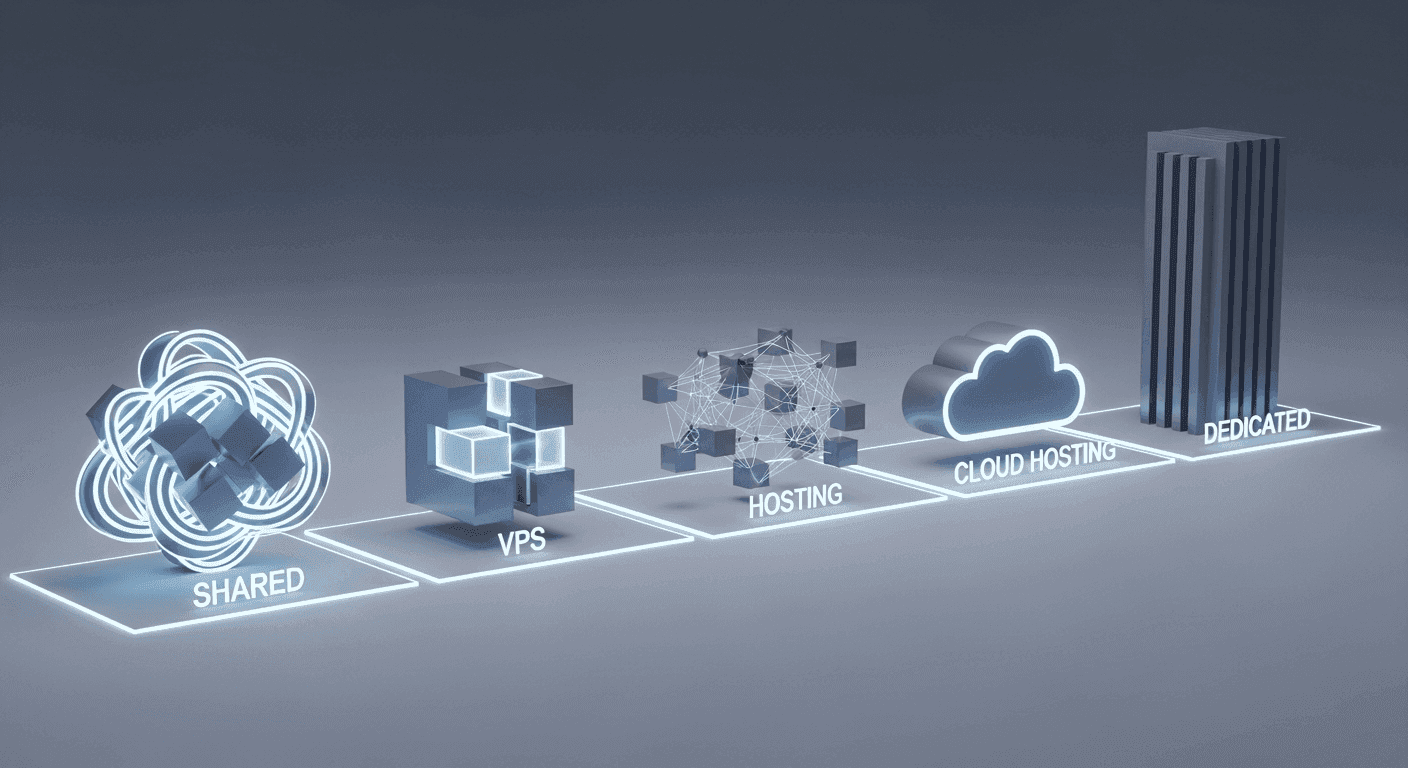
Starting an online presence, personal or business, always begins with web hosting. It's not a static choice; as your website grows, its hosting needs evolve. Understanding these stages—from shared resources to dedicated environments—is crucial for maintaining performance, security, and a seamless user experience.
This guide explores common hosting types: Shared, Virtual Private Server (VPS), Cloud, and Dedicated. We'll detail what each offers, when it's the best fit, and how to strategically transition between them to support your website's growth without overspending or underperforming.
Shared Hosting: The Economical Starting Line
Shared hosting is the most common, budget-friendly option, ideal for individuals and small businesses. Your website resides on a single server alongside many others, sharing resources like CPU, RAM, and disk space. Think of it like an apartment building sharing utilities.
Advantages include low cost and ease of use, as the provider manages server maintenance and security. However, shared resources mean a neighbor's traffic surge or problematic site can impact your performance. It’s perfect for low-traffic sites, personal blogs, or small business brochure sites.
VPS Hosting: Your Private Slice of Power
When your website outgrows shared hosting, a Virtual Private Server (VPS) is often the next step. While still on a shared physical server, it's partitioned into independent virtual environments. Each VPS acts like a dedicated server, guaranteeing your own allocation of CPU, RAM, and storage.
This provides a more stable and reliable environment. You gain greater control, often with root access, allowing custom software and configurations. Though requiring more technical knowledge or a managed plan, enhanced performance, security, and flexibility make it excellent for growing businesses, e-commerce, and moderate-traffic applications.
- Your website experiences noticeable slowdowns during busy periods.
- You frequently receive "resource limit exceeded" notifications.
- You need specific server software or configurations not allowed on shared hosting.
- Your website's security requirements are becoming more stringent.
- You desire more control and customization over your hosting environment.
- Your online store or application is experiencing consistent user growth.
Cloud Hosting: Scalability on Demand
Cloud hosting departs from single-server models. Your website's resources are distributed across a network of interconnected servers. If one fails, another takes over, ensuring high availability. This distributed nature also allows resources to be scaled up or down instantly.
Its primary advantage is incredible scalability and flexibility. You can quickly allocate more resources during traffic spikes and reduce them afterward, often paying only for what you use. Ideal for unpredictable traffic, large applications, or those needing global reach and maximum redundancy. Management can be complex, and costs fluctuate, requiring careful monitoring.
Dedicated Hosting: Unrivaled Power and Control
At the pinnacle is dedicated hosting. You lease an entire physical server exclusively for your website or application, gaining complete control over its hardware, OS, and software. It's like owning your own house, offering total freedom and privacy.
This exclusivity means maximum performance, security, and reliability. It's the choice for very large enterprises, high-traffic sites, mission-critical applications, or those with strict compliance needs. Though the most expensive and technically demanding (unless managed), it provides unparalleled power for the most demanding online presences.
Making the Right Transition for Your Hosting Evolution
Deciding when and how to transition is strategic. Regularly monitor performance, traffic, and resource usage. Consistent slowdowns, frequent downtime, or hitting resource limits are clear signs you're outgrowing your plan.
Consider your budget, technical comfort, and future growth. Many providers offer managed services for advanced hosting types, easing the technical burden. Always back up data before migration, and research new providers to ensure they meet your needs and offer seamless support. Your hosting journey is an evolution; choose the right environment for a robust and responsive online presence.
Sources & Further Reading
- Shared web hosting service — Wikipedia
- Virtual private server — Wikipedia
- What is a dedicated server? — IBM Cloud
- What is Cloud Computing? — AWS